Estimating renewable generation and homes powered: methodology
Summary
DESNZ published its methodology for converting renewable capacity into generation estimates and 'homes powered' figures used in government communications. The department applies standardised load factors from CfD Round 7 frameworks, accounts for grid losses using DUKES data, and compares results against median household consumption rather than mean to avoid skewing from high-consumption households.
Why it matters
This is a transparency exercise that reveals how government creates headline figures rather than a policy change. The methodology shows government communications use economic curtailment assumptions and median consumption to produce politically useful comparisons, but these metrics bear no relation to actual system operation or market pricing.
Key facts
- •Uses CfD Allocation Round 7 load factors for generation estimates
- •Applies system-wide loss proportions from DUKES data
- •Uses median rather than mean household consumption to avoid skewing
- •Accounts for economic curtailment in load factor assumptions
- •Compares generation against regional consumption data for area equivalences
Areas affected
Related programmes
Memo
This methodology note sets out how the department estimates annual electricity generation from renewable energy capacity. It explains how installed capacity is combined with standardised load factors and system‑wide electricity losses to produce generation estimates, and how these estimates are compared with electricity consumption statistics to create “homes powered” and regional equivalence figures used in government communications. --- ## Summary The note sets out the Department’s approach for estimating annual electricity generation from renewable technology. Our approach uses project generating capacities combined with standardised load factors and applies system-wide electricity losses to estimate annual generation. We compare this generation to electricity consumption statistics to produce meaningful comparisons. ## Estimating Renewable Generation Figure 1 shows how we calculate electricity generation. We take a renewable generation plants maximum generation capacity and scale it for the time that we estimate it will be producing electricity over the year. This estimated generation is then reduced to account for losses as the electricity travels over the electricity grid to reach the end consumer. 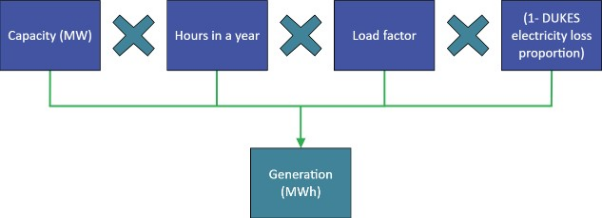 Figure 1: Electricity Generation Calculation There are three core components need to calculate our generation figure: Capacity: This is the maximum electrical power output that a renewable energy installation is designed to produced. It is expressed in Megawatts (MW). Load factor: The load factor is the ratio of the actual electricity generated by the renewable energy system compared to its the maximum feasible electricity production over a period. We use standardised load factor assumptions taken from CfD Allocation Round 7 and 7a Allocation Framework[[footnote 1]](#fn:1). Application of the load factor ensure that our generation estimate accounts for the fact that renewable generation is not constant but intermittent, actual renewable generation varies according to factors such as wind conditions or cloud cover. The load factor also accounts for estimated economic curtailment, to reflect that plants do not always generate if overall national supply is greater than demand. Loss proportion: This is an estimate of the electricity lost as it travels over both the transmission and distribution network. We have calculated this loss proportion from the Digest of UK Energy Statistics[[footnote 2]](#fn:2) (DUKES)[[footnote 3]](#fn:3). Combing these factors together with the number of hours in the year estimates the electricity generate from a plant over a year that reaches people’s homes. In practice, actual generation fed into the grid can be lower due to network curtailment. This is when renewable generators are instructed to reduce output to maintain the electricity system’s stability, due to physical constraints on the electricity network. ## Homes powered methodology The estimate of the homes powered figure reflects the equivalent number of homes that could be powered through the annual electricity generation of the installed renewable generation capacity. Figure 2 illustrates how the home powered estimate is calculated. 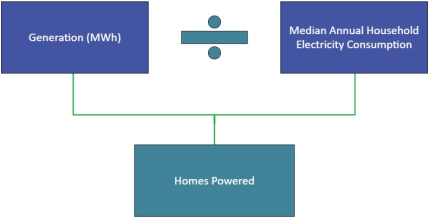 Figure 2: Homes powered estimation We combine the generation estimate outlined above with the median annual household electricity consumption figure for the relevant region. This provides an estimate of the equivalent number of homes that could be powered from a set amount of electricity generation. We take the electricity consumption values from the Stacked electricity consumptions statistics[[footnote 4]](#fn:4) publication. This dataset includes households that consume a large amount of electricity, skewing the average. To avoid this we use the median. ## Region equivalence An alternative comparison to households would be to compare the electricity demand of specific areas. This compares the generation estimates with data from the Regional and Local Authority Electricity Consumption Statistics[[footnote 5]](#fn:5). This dataset provides annual domestic, non‑domestic and total electricity consumption for all regions and local authorities in Great Britain. 1. [Contracts for Difference (CfD) Allocation Round 7: allocation framework - GOV.UK](https://www.gov.uk/government/publications/contracts-for-difference-cfd-allocation-round-7-allocation-framework) [↩](#fnref:1) 2. [Digest of UK Energy Statistics (DUKES): electricity - GOV.UK](https://www.gov.uk/government/statistics/electricity-chapter-5-digest-of-united-kingdom-energy-statistics-dukes) [↩](#fnref:2) 3. Whilst the DUKES data includes Northern Ireland, this is a relatively small proportion of overall UK electricity consumption, thus the resulting loss proportion provides a reasonable system‑wide approximation for modelling electricity delivered to homes in Great Britain [↩](#fnref:3) 4. [Stacked electricity consumption statistics data - GOV.UK](https://www.gov.uk/government/statistical-data-sets/stacked-electricity-consumption-statistics-data) [↩](#fnref:4) 5. [Regional and local authority electricity consumption statistics - GOV.UK](https://www.gov.uk/government/statistics/regional-and-local-authority-electricity-consumption-statistics) [↩](#fnref:5)